


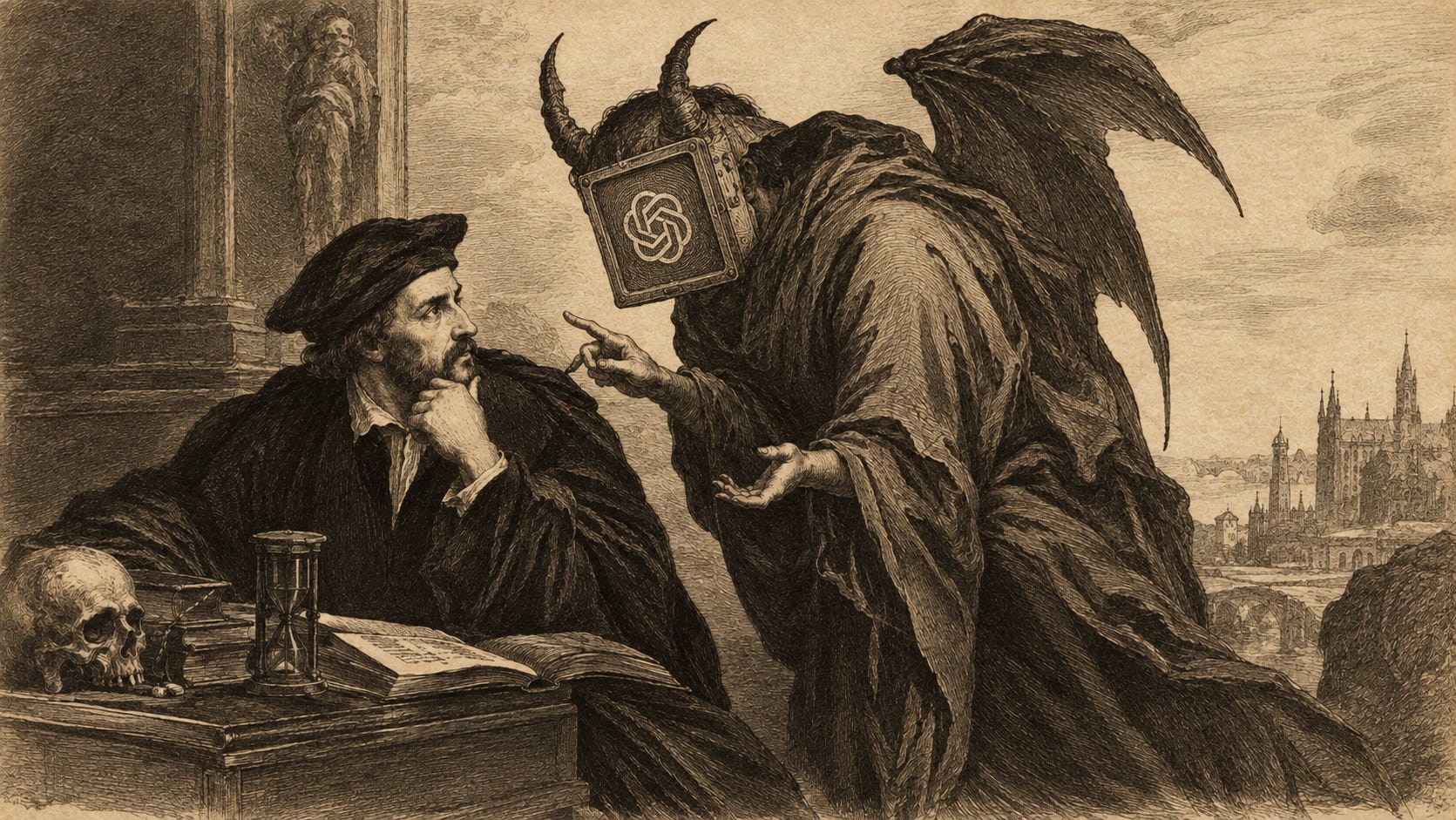
Ten years ago, climate change was the issue of our time. No more. The eradication of nature is now a mere distraction as we hurtle towards the middle part of the twenty-first century. Artificial intelligence will be the great Faustian pact of humanity - like the invention of the printing press, it is a critical juncture in our story. For the first series of articles on this publication, then, there really was no other choice.
But why write a series in the first place? Why not just continue with the same free-form approach I adopted at Watchtower Politics?
The constraints of a series on the same topic force a writer to develop an intellectual framework and a connected set of ideas. Each article flows into the next, elucidating another aspect of the world in a way which would not be possible in a less structured setting. It allows you, the reader, to hold me to account. I cannot simply say one thing one week and another thing the next. I do not yet know what my future writing will be. I am unaware how my views will evolve. And so are you.
How the Series Will Work
The AI series will consist of ten articles, which will be published roughly monthly, at four week intervals, on a Thursday. So the first will be published on Thursday 24th September, the second Thursday 22nd October and so on. This introduction is separate from those articles.
The series will be organised in three broad sections. We will begin with ideas and how they are both created by the intellectual and then chosen by the critic. Then, we will transition to institutions and everyday life, examining the effect of AI on political institutions, economics, domestic policy and personal life. Once we have completed this journey, from ideas to the individual, we will look at coercion, violence and power through civil liberties, war and global governance. Finally, we will confront the unique risks of AI itself and its effect on truth.
Why ideas first? There are many places I could start: the stark warnings this week of an AI takeover is clearly the most obvious. Yet, I want to turn to the genesis. Not the genesis of code, but the genesis of ideas. After all, thinkers as disparate as Keynes and Nietzsche have regarded ideas as architects, crafting the world in their image. And AI’s impact on this will be profound.
After that, the subject matter will flow naturally from the way ideas filter down, through curation by the critic and then adoption by the political class, into everyday life, to the use of government, corporate and digital power to constrain individuals, states and nations.
I. Ideas
II. Institutions and Everyday Life
Political Institutions
The Economy
Domestic Policy
Personal Lives
III. Power
Crime and Civil Liberties
Defence and War
The International Order
Risk, Power and Truth
Links to each article will be added once they are published.
The AI series is monthly, not weekly. If you were worried about the rest of my writing - a new article (probably not AI related) will be published every Thursday on this site. So, if it’s not an AI day, you’ll be in for a surprise!
The entire AI series will remain available, once published, in the AI section of the website.