


“But apart from this contemporary mood, the ideas of economists and political philosophers, both when they are right and when they are wrong, are more powerful than is commonly understood. Indeed the world is ruled by little else”
J.M. Keynes, The General Theory of Employment, Interest and Money
The emergence of artificial intelligence means accessing information has become extremely cheap. Even now, it is possible to ask AI to curate reading lists, analyse arguments and review work. As its capabilities increase, it will soon reach a level at which it can perform functions that were once mostly limited to universities. Once this democratisation of learning is complete, self-taught individuals, free from institutional groupthink, can create works of genius that sparkle against the dark mass of mediocrity.
Finding those works is the role of the critic. I shall examine that next month.
The Role of Philosophy, History, Politics etc.
Philosophy, history, politics, political economy, classics: these subjects (which I will label humanities for ease) pose a problem for the educational instrumentalism of our age. Only two weeks ago, Chris McDonald, the Labour minister, launched a fresh offensive for STEM subjects, arguing that they offered “the greatest personal, social and economic value” to the individual. Yet those comments, well-intentioned as they are, betray a deep misunderstanding of the world.
This isn’t to insult science, mathematics or modern languages. The cumulative nature of knowledge, as well as the constraints of the school day, means that STEM, English and MFL are prioritised by schools up and down the land. Practically, that makes sense. We don’t need philosophers like we require doctors nor do we require historians like we need engineers. We cannot perform titration experiments in the kitchen but we can read Thucydides.
The skills and employment prospects that STEM provides make its instrumental economic value self-evident. Less obvious are the advantages of humanities. They cannot be listed as a litany of practical abilities nor as an applicable library of knowledge. Their virtue lies in a holistic conception of humankind; they provide insight into the why and the how. And so we have a critical problem. The foundational subjects for understanding and organising society are also the least essential to the everyday functioning of that society. So they are neglected. It is an issue which extends into higher education.
At University
“You dropped a hundred and fifty grand on an education you coulda picked up for a dollar fifty in late charges at the public library”
Matt Damon, Good Will Hunting
The scene in Good Will Hunting where a Harvard student tries to impress a girl by pretentiously spouting what he had learnt at his alma mater before the self-taught Will Hunting promptly puts him down, illustrates this problem. These subjects are primarily studied by reading and then by writing. The role of the critic first, the creative second. Teaching takes a back seat to self-study; instruction is supplementary.
And I have experience of this. I read Philosophy, Politics and Economics at Oxford. The vast majority consists of reading. There are also optional lectures that are functionally similar to online lecture series run by other institutions. The real point of difference is the tutorial system, where you are rigorously grilled by your tutor, usually with one other student. Most universities have no such system.
There are two advantages conferred by universities that you cannot get from self-study. Firstly, time. With a full-time job, devoting substantial chunks of your life to studying history or philosophy becomes increasingly difficult, unless you have substantial wealth. Secondly, the economic and social status degrees confer. Our Harvard student from Good Will Hunting understood this perfectly. Those interested in the humanities will be shut out of parts of the labour market without the qualifications to signal their economic value.
Of course, universities also provide numerous non-academic advantages: the chance to live away from home in a controlled environment, a wealth of social opportunities, the chance to get involved in societies and clubs. Yet, from a purely intellectual perspective, the marginal advantage of attending university is shrinking. They might provide a curated reading list, a lecture series which you don’t have to find online and the chance for discussion and critical thinking in some kind of seminar format, but the uniqueness of their academic expertise was already fading even without Artificial Intelligence.
With AI the picture is even starker. It is not difficult to see even Oxford’s world-class tutorial system being surpassed by ever-advancing artificial intelligence. How long will it be before an LLM can provide the rigorous cross-examination of an undergraduate tutorial? In this world, the advantages of university will increasingly become lifestyle-related rather than academic.
The Great Thinker
When you imagine the great scholar, the great thinker, the genius, I suspect a certain image comes to mind. Perhaps the Platonic ideal of Immanuel Kant strolling to deliver lectures on a rainy Königsberg morning before his afternoon walk and an evening writing a few pages of A Critique of Pure Reason. Yet, in truth, this is a relatively modern idea.
Plato travelled outside any formal educational apparatus before founding the Academy in Athens. Tacitus wrote The Histories after reaching the height of his political career. Hobbes penned Leviathan whilst in exile tutoring the future Charles II. Marx spent his time researching Das Kapital, not in a university department but in the British Museum. Rousseau was working as a secretary and a musician before winning the essay prize that brought him widespread fame.
One could just as easily provide a list of counterexamples: Aristotle, Aquinas, Hegel, Locke, Smith, Hayek. It would be pointless. The idea is not to describe one as greater than the other or to prove greatness lies in the maverick, not the insider - strangely, it appears remarkably even - but to acknowledge that educational institutions do not have a monopoly on scholarship.
What is required is a means by which scholars can learn. This is exactly why universities are so effective - they provide people with time, resources and interlocutors to learn. Our outsiders also had this. Marx, for example, had access to the British Museum, frequent discussions with Engels, who also supplied him with funds. Crucially, these means are becoming democratised by AI.
The Individual Unleashed
The principal academic advantages of university are increasingly available elsewhere. The concentration of bodies of thought within institutions leads to more homogeneous perspectives. Much of what they offer - discussion, critical analysis, curation - is now also provided by AI. This gap will only narrow as AI gets better and better. If most of what university professors provide is replicable by AI, then they look an awful lot like a typewriter in 1980.
Instead of a standardised institutional experience, AI tailors learning to the individual. Used correctly, it is an intellectual weapon like no other. Not as a writer, but as a tool that recommends, advises and criticises - one which serves as a personalised way of studying and allows the individual to create their own tapestry. The right prompt transforms learning from something handed from above to something emanating from inside the individual. Something powerful, something original, something extraordinary. A radically egalitarian instrument of inequality which lets greatness soar and mediocrity drown in its own abundance.
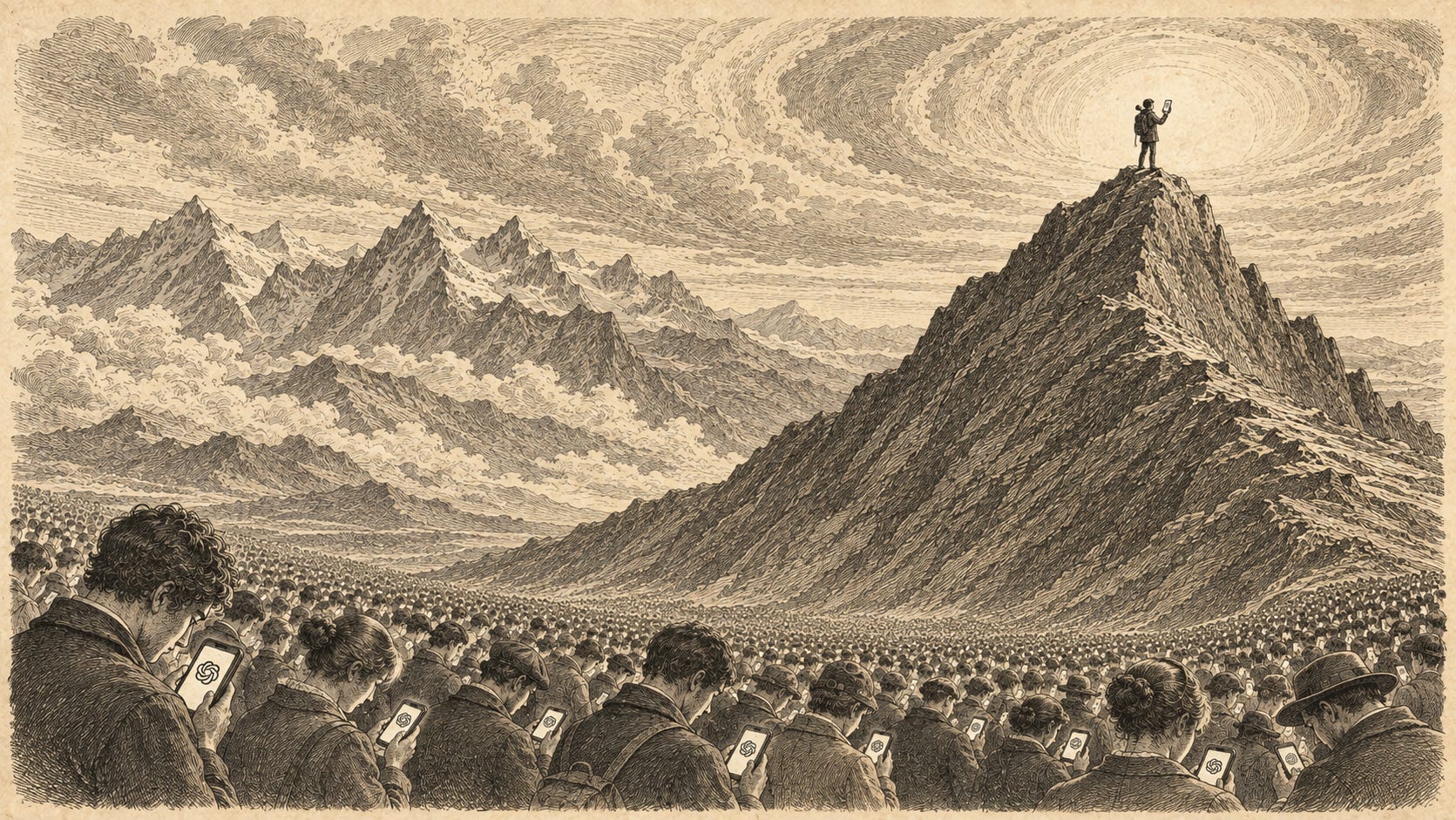
Just imagine, in some far-off corner of the world, a lone individual typing prompt after prompt into ChatGPT constructing her knowledge of the world from the neglected classics that only interest her, and her own personal AI tutor. As she slowly builds her understanding, not in the flash of a degree but painstakingly over many years, ideas occur to her, ideas that she cannot quite place. Nor can ChatGPT. So she writes and she writes and, instead of the turgid, hierarchical stasis of academia, she has an intellectual partner at her fingertips. Soon, it is finished. And it is a masterpiece! But who picks it up? Who reads it? Who distinguishes it from the AI dreck produced by the masses?
Because most people aren’t geniuses. Even with the help of AI, most people won’t produce works of stunning originality. The internet will be awash with derivative drivel written by authors with pretensions in excess of their quality. Most will use AI improperly, turning it into a regurgitating sycophant. In an overwhelming ocean of mediocrity, how do we find Thus Spoke Zarathustra? The Wealth of Nations? The Aeneid?
That is the role of the critic. That much-maligned profession is invaluable in the coming age. It is there I will turn next month.
This is the first part of a ten-part series on Artificial Intelligence. The next article will be published on 22/10/2026.
A fascinating argument for how AI could democratise learning while making genuine originality harder to discover. I especially like the distinction between using AI to think more deeply and using it as a substitute for thinking, the future role of the critic is an intriguing question!
This is a very interesting series idea Thomas. I look forward to next Thursday’s article!!