


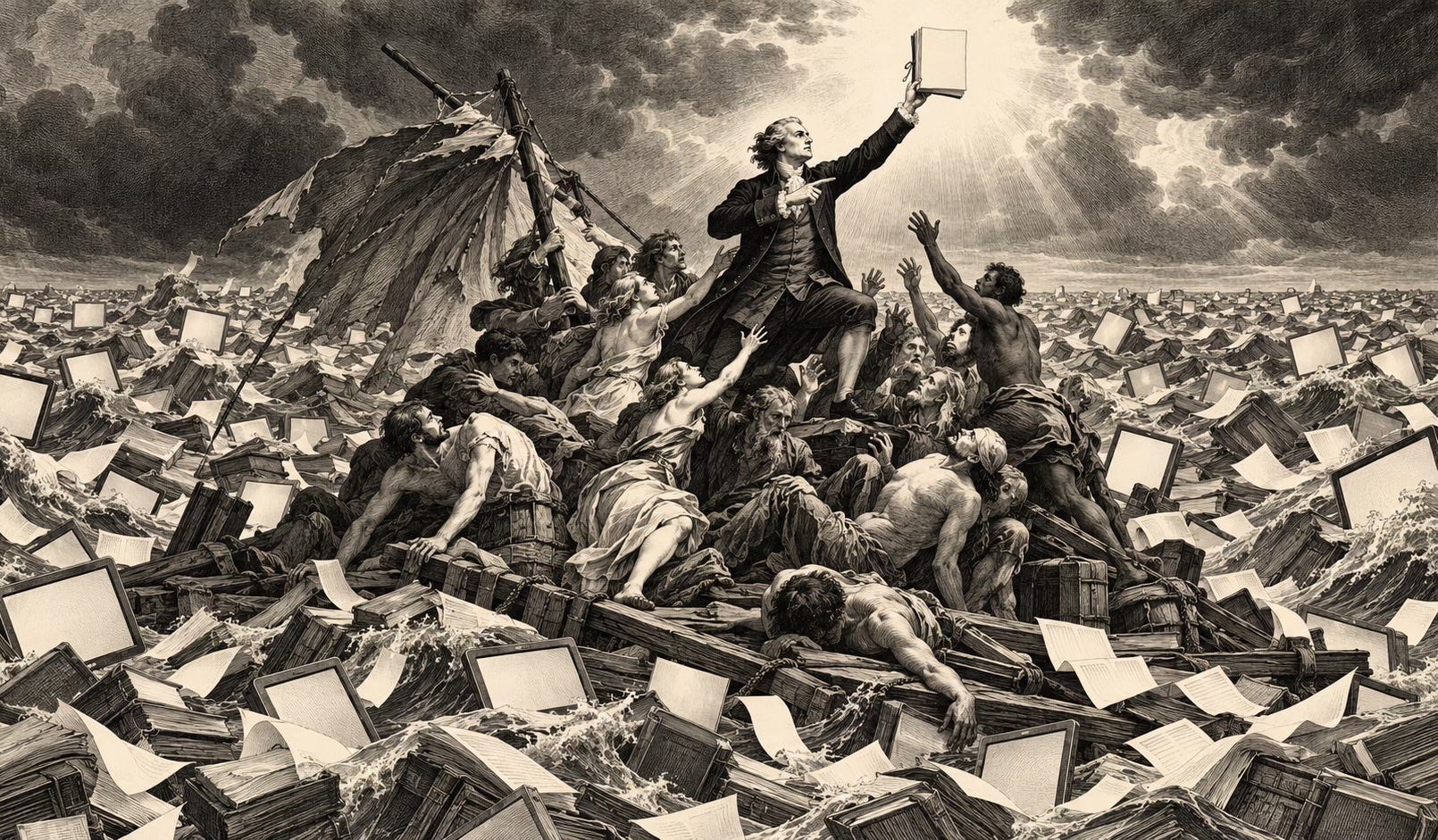
“The internet will be awash with derivative drivel written by authors with pretensions in excess of their quality. Most will use AI improperly, turning it into a regurgitating sycophant. In an overwhelming ocean of mediocrity, how do we find Thus Spoke Zarathustra? The Wealth of Nations? The Aeneid?"
Tom Roxburgh, 2026
Last month, to kick off this series on the rise of Artificial Intelligence, I wrote of the explosion in content that will inevitably occur. This leads us to a significant problem. How do we separate the genius from the mundane? In this essay, the critic steps forth as the professional uniquely positioned to dismiss the sewage and hold aloft the transcendent. Yet, unlike part 1, this is by no means an inevitability.
The Maligned Profession
“It is not the critic who counts; not the man who points out how the strong man stumbles, or where the doer of deeds could have done better. The credit belongs to the man who is actually in the arena, whose face is marred by dust and sweat and blood, who strives valiantly: who errs and comes up short again and again…”
Theodore Roosevelt, 1910
No one likes the critic. Sitting snootily at a distance from the action, they have the power to make or break a career with the strike of their pen. There is nothing more spine-tinglingly loathsome than a man or woman slouching in judgement, like some spoilt medieval king, and obliterating a man’s life for sheer distaste. It goes against our instincts to allow someone we regard as a failure to take charge of other destinies: for someone without a stake to judge those who dared.
The particular disgust towards the critic stems, I think, from their tremendous power to shape opinion and influence culture. But why the critic, you might ask? Why should we allow this profession to dictate the merits of certain works? And the problem is one of miscommunication rather than disagreement because we already do. Whilst there is an inherent hostility to criticism in culture, particularly popular culture, there is far less resistance in the academic world.
Because a large swathe of academia is criticism. Whether it is of what others have written yesterday, or what Plato wrote two and a half thousand years ago, the academic thrives on response. Even the Greats, whose contributions far exceed their critique, were performing the role of the critic by the simple act of response.
This can take the form of a commentary (Machiavelli’s Discourses on Livy), a direct rebuttal (Nozick’s Anarchy, State and Utopia) or a historiographic critique of previous literature (Nietzsche’s On the Genealogy of Morality). Criticism can take subtler forms too: treating older writers as thinkers worth answering, as Locke did with Hobbes, and, therefore, determining what survives. In responding to some works rather than others, thinkers help establish a canon. The only difference with the AI revolution is that the volume of work makes critics more important, not less.
But why the critic?
I still haven’t answered your question. Even if academia is a form of criticism and we have accepted it for years, it doesn’t necessarily follow that the critic is the premier judge. To make the case, I’m going to look at film criticism - maybe the most contentious and distrusted of all.
Let’s imagine two people. One is the aforementioned film critic and the other a highly intelligent adult who has never watched a film in his life. Who do we think the better judge of the film will be? The novice may have a certain advantage: a freshness, perhaps, and an ability to relate to things beyond the cinema. But the film critic’s knowledge is far broader, leaving him in a much better position to contextualise the motion picture. For the beginner, it’s both the greatest and the worst film ever made.
Okay, Tom, fair enough, but what about the layman who has watched lots of films but not as many as the critic. Surely their opinion is just as valid as the critic’s? Well, no, not in the sense of value. They may have an opinion of the film that more accurately aligns with your own opinion, but their opinion is unquestionably less well-informed. With greater breadth and deeper knowledge of a subject area, the critic is in a better position to evaluate the film and, therefore, their opinion is of more value.
This is not about agreement - critics, after all, disagree vehemently - but about quality of argument. I strongly dispute Pauline Kael’s pan of Raging Bull, for example, but still find a certain insight that would not be there in the everyman’s “don’t like it, it was boring”. It is not that a critic’s opinion is more or less likely to be correct or to agree with you but that their opinion is of a substantially different quality.
So, if that’s the case with film criticism, then the case for the critic of philosophy, politics, history and economics should be a lot easier. These are subjects that require specialist knowledge to understand, even on a basic level. Unlike film, the average Brit is not going to pick up Kant and understand it, even superficially. For these subjects, the need for specialist knowledge is even more stark.
It’s not only specialist knowledge and sheer accumulation of aesthetic experience that the critic holds over the audience, though. They also possess a more sophisticated understanding of the interplay between one text and another, can identify a genuinely original argument and can exercise independent judgement. Most of all, the critic has the professional time and ability to cultivate these things.
The Counterfactual
“Because something is happening
But you don't know what it is
Do you, Mister Jones?”Bob Dylan, Ballad of a Thin Man
The alternative is much more unpleasant. Imagine the world I described before: a place awash with works of contemptible averageness, the volume of which is simply too large for any human to comprehend, let alone read. Without a filtering mechanism, without quality control, we will be completely overloaded - unable to keep up with the sheer slop produced every day. This is already happening on streaming services, which pump out content at a pace where reflection and curation cannot keep up.
AI would be the obvious alternative. Not beset by the sporadic subjective errors of judgement that sometimes plague a critic, it might prove to be a more consistent arbiter of quality. And I partially concede this: AI would have the ability, given the right prompt, to evaluate the strengths of different works.
Critics, after all, get it wrong. Modernity can pass an old critic by, leaving them lost in the fire of time - just ask Dylan’s Mr Jones. Yet, there is something that AI would be more likely to miss: the immeasurable spark that animates most, if not all, of the great works cannot be reduced to mere words or existing aesthetic criteria. If a human encountered Shakespeare’s work with no current standard to judge it by, the art would lead him to abolish the very standards he relies upon. If AI sat in the Globe, Hamlet would still pass it by.
Unlike with our lone genius who employs AI as a creative tool, this is asking AI to mass-curate. If AI is used in this way, there would be no scope for humans to push back or suggest something different. The predictive nature of LLMs means that good works, maybe even great works, will be found but they will revert to conventionalism. The outsider, the loner, will be lost. Even if AI gets it right ninety-nine times out of one hundred, the one time it matters it will fail.
And that’s why the critic must be indispensable. The quality of their criticism means that even if their opinion is wrong, their review is still valuable. Even if they dismiss the genius, the well-informed critic who acts in good faith will still provide insight, still admire a certain quality of the work. This itself is an important record in the establishment of a canon.
Without the critic, we will struggle to identify the ideas that matter. And if we lose ideas in the clutter, we could lose civilisation.
Criticism Reborn
“Indeed, that’s really what I’ve been doing for the 55 years since I began appearing in print. I always just wanted to bang a drum announcing the greatest shows on earth, the films that constituted the alternate universe for me ever since I could remember.”
Andrew Sarris, New York Observer, 2008
And so the critic must be reborn. Not as the spirited amateur but as a hard, seasoned professional. If we are not to drown in the sea of content, we require a lifeboat and a compass. The critic provides the ability to sift the new from the old, the great from the mundane and the inspired from the worn.
As the rapid democratisation of learning allows genius to spring forth from outside traditional circles, academia’s purpose should be remodelled on the relationship between the artist and the critic. Then, its weaknesses become strengths: the discipline, the reliability, the emphasis on restraint. All those things that hamper originality can serve the critic.
Of course, there will be people who move between the two roles - as there always are - but not nearly as many as now. The critic will need reactive individuality but not radical originality and their greatness will be limited but their influence infinite. And so, the world of ideas will morph and universities will be the guardians of quality, not the engines of transcendence.
But the ideas will live on. And, sooner or later, it is ideas that govern us all.
That is where I will turn next time.
This is the second part of a ten-part series on Artificial Intelligence. The next article will be published on 19/11/2026.