


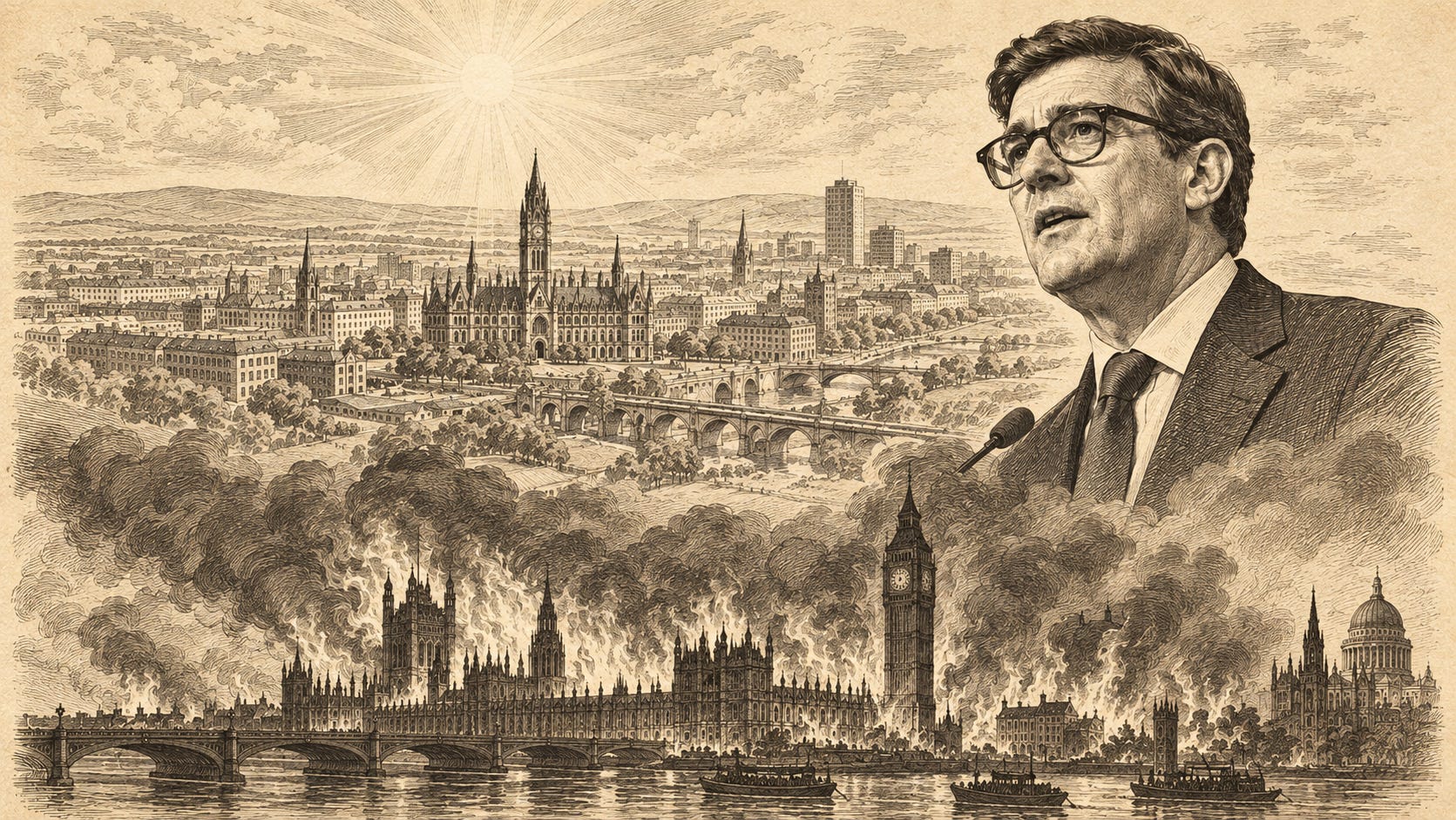
“Britain is not perfect. It can be better and we will make it so. But it still stands for something worth saving, worth fighting for.”
Andy Burnham, September 2026
For the first time since at least Tony Blair, and maybe Margaret Thatcher, we have a leader with a radical vision for the country that isn’t composed of half-baked marketing slop or clever consulting catchphrases. This isn’t a politician driven by ideas from behind the throne (Theresa May), or by the raw pursuit of power (Boris Johnson, Keir Starmer) or even one who defines themselves as a safe pair of hands (Rishi Sunak). Andy Burnham doesn’t want to be Prime Minister. He wants to be a Great Prime Minister.
His summer “tour” of the country that heralded a thousand social media clips, ranging from “splitting the G” to pontificating about the correct word for “bap”, showcased his folksy charm but his conference speech revealed a gravity of purpose. His critics hated the litany of small, arguably pointless, policies. Like Nero, he had fiddled while Britain burnt. No more.
Whatever you think, he’s no longer fiddling. In pledging to reform the pensions triple-lock to fund a National Care Service, he has grasped the third rail of British politics and risked handing an election to Farage or Badenoch. It is a move of stunning bravery but also significant guile. The triple-lock had to change. Burnham, at least, has used the savings to pay for social care - something that also affects older people.
Thus, the complaint cannot, or at least should not, be made that Burnham is robbing the pensioners to pay for the young, or the disabled, or those on benefits. He’s using it to fund an essential saving for the NHS that will overwhelmingly benefit older members of society. A National Care Service will reduce pressure on hospital beds through fewer ambulance callouts and A&E admissions whilst also improving the level of care for the elderly.
Ironically, the political project closest to Burnham’s in style is Margaret Thatcher’s. A man intent on rolling back the Thatcherite revolution is replicating its radical tendencies. As Thatcher moved to the right, Burnham has shifted to the left. As Thatcher rolled back the frontiers of the state, Burnham wants to re-impose them. As Thatcher dismantled the 1970s, Burnham seeks to re-constitute the post-war settlement.
The biggest difference in the political landscape is the bland banality of the current opposition, which repeat platitudes of various kinds but refuse to meaningfully engage with Britain’s decline. Badenoch likes to be known as the person who “makes tough decisions”, itself a vacuous marketing line, but limits these to playing to her base with benefits cuts, leaving the ECHR and ending Net Zero. Farage, on the other hand, responded to the speech by lambasting the foreign aid budget and immigrants. To quote Bond, “shocking, positively shocking”.
Leaving aside the change to the triple-lock, Burnham also promised greater public control of water companies, electoral reform and a reset with Europe (which has now developed into discussion of rejoining). These are substantial policy announcements that represent a new direction for the country and a fresh battleground for the next election. It may be that Burnham is wrong. His policies may well be bonkers. He could just be a time-travelling nutter who has decided Margaret Thatcher is the Antichrist.
The only thing I endorse is vision, the only thing I condemn is cowardice.
In my view, Burnham’s ideas range from sensible to deeply flawed but his speech had me salivating because of its character. Because he’s serious about changing Britain. And if Britain wants to start taking itself seriously again, Burnham has offered a path. At the moment, it is the only visible path. As the opposition parties repeat banal phrases that fix nought but a campaign slogan, Labour’s leader has stepped forth and announced the slaying of the sacred cow of British politics.
Do not take this as endorsement or criticism. The only thing I endorse is vision, the only thing I condemn is cowardice. Kemi Badenoch may talk about how she makes the hard choices but there’s only one person with a dream of Britain. As Burnham’s road unwinds, there is only one obstacle left. One obstacle before he can unleash his fateful revolution of state, society and economy. A revolution as consequential as Thatcher’s, for better or for worse.
He has to conquer the country…