


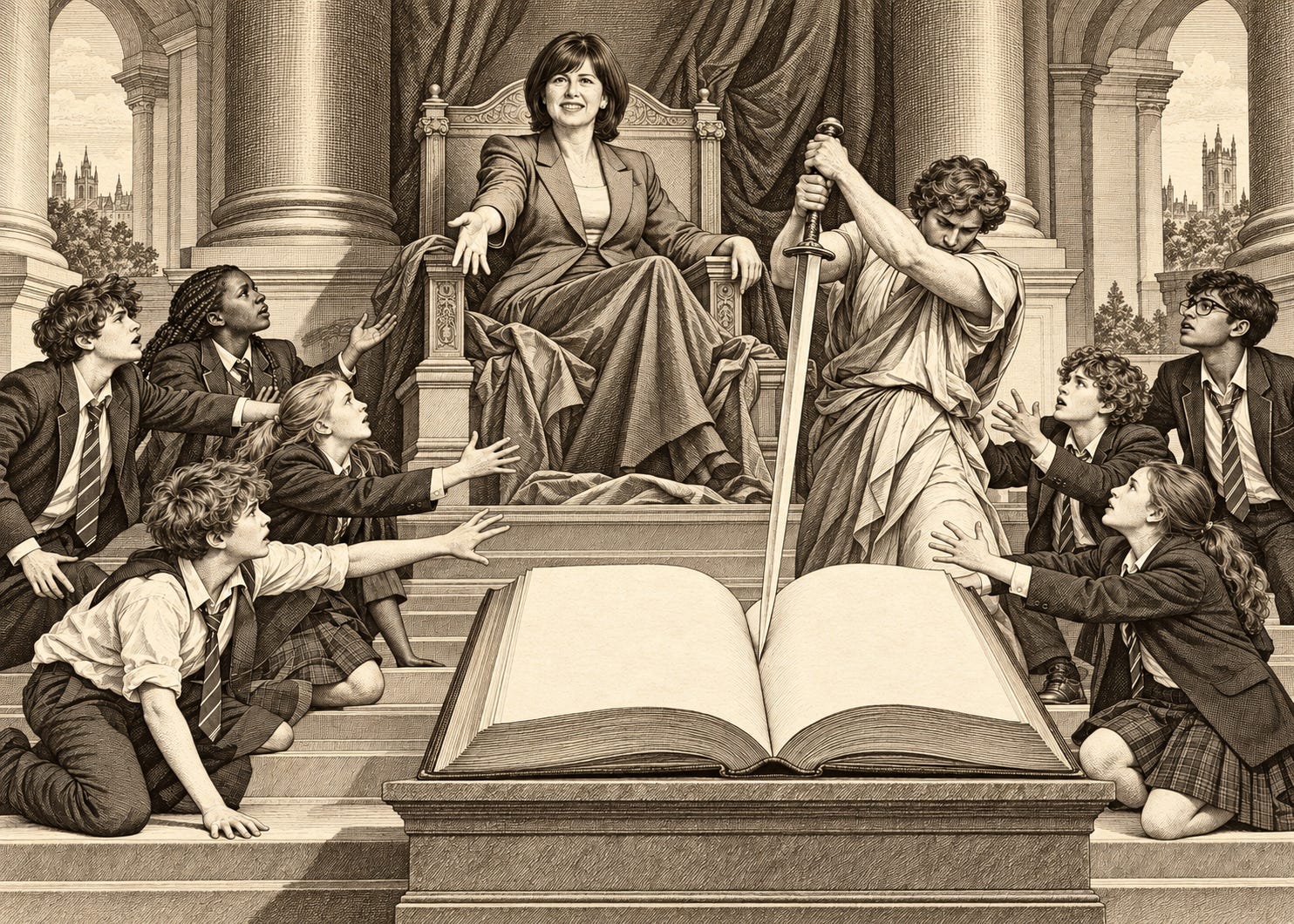
“If it's the last thing I do, I'm going to destroy every fucking grammar school in England.”
Anthony Crosland, 1965
The Labour Party has a problem with education. Sometimes it feels that they would rather generate outrage than admit that the Conservatives might have got something right. Between 2012 and 2025, England rose in the PISA rankings from 18th to 8th in science and from 23rd to 9th in reading. Most impressively, the country climbed from 25th in the world for mathematics to 10th. This came after Michael Gove’s reforms which were informed by several high-performing East Asian approaches.
These are huge improvements. Wales and Scotland, governed by Labour and the SNP, lag conspicuously behind. Though it’s our relative global position that has improved, the knowledge-rich curriculum in England’s schools has proved more resilient to the overall negative trend in attainment over the past five years. Blair may have prioritised “education, education, education” but it was Gove, amidst rampant budget cuts, who has delivered it.
Yet, despite this marked improvement, Powell and Burnham criticise those reforms for reducing the value of vocational subjects and narrowing the curriculum. They look at the continued, but decreasing, dominance of private schools in university admissions and job statistics and conclude that the problem must be that they prepare students better for life beyond education. They’re right.
However, the solution they propose – replacing technical awards with new vocational qualifications – puts in jeopardy England’s progress over the past fifteen years. Emphasising vocational rather than academic routes means that some kids will be pushed into qualifications seen as second-rate because of their background. Powell denies the emergence of such a two-track system.
Although the education secretary can control the law, she cannot control opinion. Whether the government regards vocational qualifications as on par with academic GCSEs is beside the point. What matters is what employers, parents and schools think. Inevitably, the subject choices that lead to traditionally working-class occupations (vocational) will be seen as inferior to those that are more conducive to middle-class professions. Britain’s historical problem with class cannot be dismantled in three years.
The question, of course, is whether this new focus on vocational GCSEs will come at the expense of academic education. Powell has promised to protect the gains in maths, English and science. However, given the limited number of GCSEs a child can take, languages and humanities, so crucial for a shared understanding of humanity, are being lined up for the guillotine. It’s also doubtful that Powell really appreciates the value of knowledge-based approaches to learning. She once claimed “what’s the point in regurgitation of knowledge when we all have the knowledge we need at our fingertips?”
The manner in which vocational subjects take over the curriculum will depend heavily on the school. This is part of the problem. Academic subjects, like Latin, are already unavailable in many state schools. How long before some only offer one modern foreign language? Or bin religious studies? Shifting the emphasis to vocational qualifications will further erode the status, and curriculum time, of subjects that are already under threat. Those subjects also offer students more chance of upward mobility.
It’s a regressive, classist move. Far from abolishing class distinctions, it will further entrench them, like grammar schools did many years ago. In the post-war Tripartite system, the grammar school sat alongside the secondary modern and the secondary technical schools: intended to be equal in status. In theory, grammars were a brilliant instrument of social mobility; an engine of aspirational meritocracy. In practice, they have no significant positive effect on social mobility. Their pupils predominantly come from high-attaining, middle-class families.
Shifting the emphasis to vocational qualifications will further erode the status, and curriculum time, of subjects that are already under threat.
The attempt to put vocational subjects on an equal footing, like dividing secondary moderns from grammars, is well-intentioned but will ultimately end up the same way. Private schools will continue to stretch their pupils academically, whilst middle-class children in the state sector will still take the academic route either through grammars or high-achieving academies. As always, it is the working class that will lose out - shunted into schools that offer vocational qualifications at the expense of academic ones. This will close off access to leading universities and the best employers.
But it is a solution to a problem that does exist. State schools do not offer enough beyond the curriculum; Powell’s mistake is assuming that vocational qualifications should supplant academic work. Her promotion of oracy and enrichment is much more astute and something private schools have done for years. Their substantially longer school day, which sometimes includes Saturday school, leaves more room for enrichment. They also view extracurricular activities as something done by everyone.
If Labour is serious about broadening the curriculum and ending the disproportionate representation of privately educated people in top jobs, it should focus on this. It won’t be an easy task. Teachers, already underpaid and overstretched, would rightly require far greater compensation and parents would no doubt complain. Yet, if we want to incorporate sport, music and drama into school life as well as equipping students with the skills to engage in the workplace without losing academic excellence, then we must lengthen the school day. Governments can’t bend time.
One thing is for certain, though. Simply replacing access to academic education with vocational qualifications is counterproductive and hurts the working class. Just like grammar schools.