


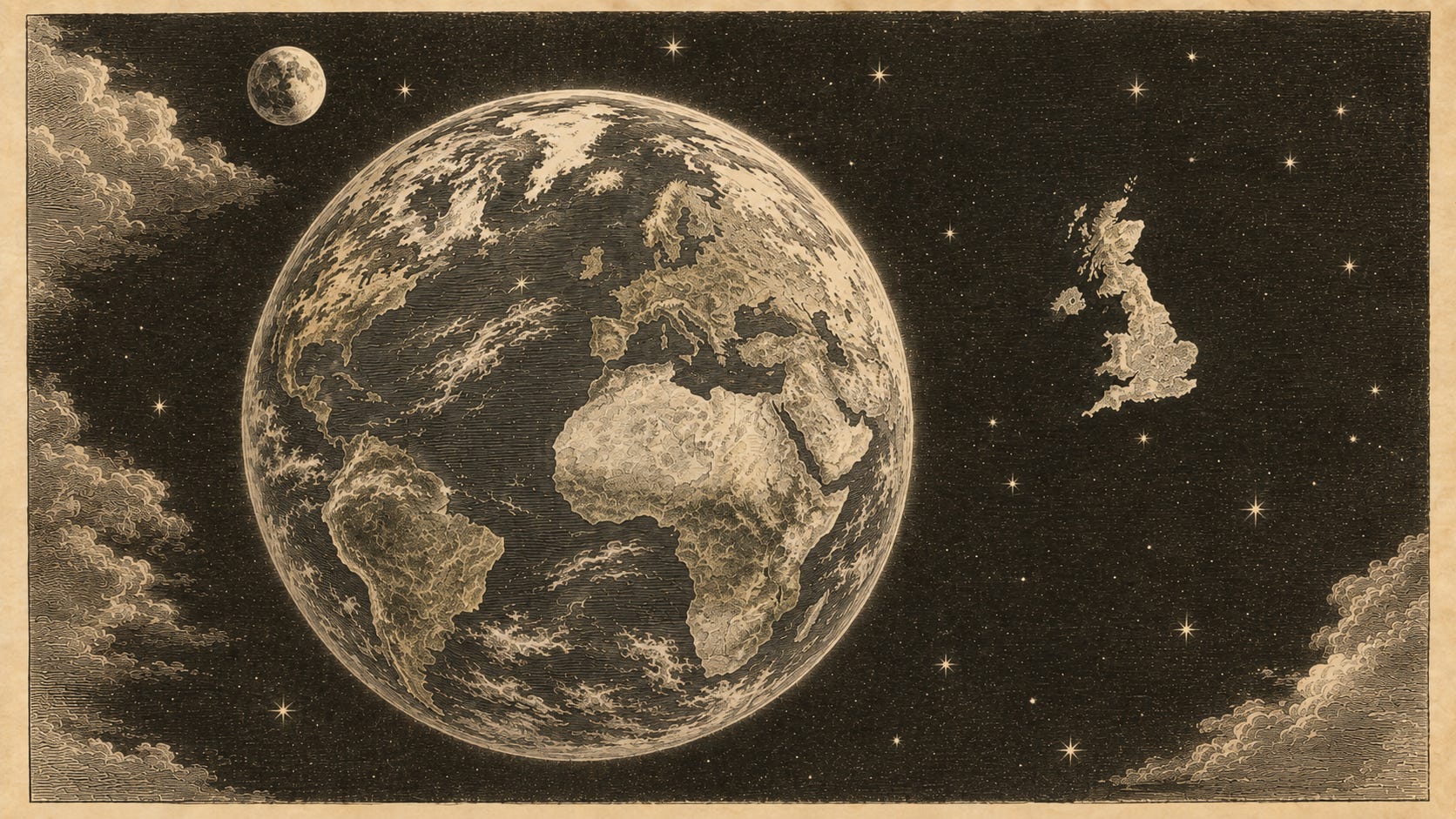
“And even if, which I do not for a moment believe, this island or a large part of it were subjugated and starving, then our Empire beyond the seas, armed and guarded by the British Fleet, would carry on the struggle, until, in God's good time, the New World, with all its power and might, steps forth to the rescue and the liberation of the Old.”
Winston Churchill, June 1940
Andy Burnham has had a busy few months on the global front: sanctioning Israeli settlements on the West Bank, joining Saudi Arabia in bombing Yemeni rebels, and reviewing the Chagos deal. He is now considering rejoining the European Union. Surprisingly, and with haste, something resembling a Burnham doctrine is beginning to emerge. Yet, that doctrine looks increasingly lonely in the modern world - a joyful centrist ode to an environment that existed decades ago.
Starmer’s dogmatic international legalism has been replaced by a nimble statecraft that emphasises projecting values through a display of strength. Yet, Burnham’s assertion of values is anachronistic, adhering to an international environment that no longer exists. The past ten years have seen a rapid disintegration of the post-war international order and a reassertion of expansionist empire-building, even in the West. It would not have been conceivable, pre-Trump, to imagine America invading Greenland or declaring that Canada should be part of the union.
Even in its most brazen realist displays of hard power, America had always maintained the pretence of acting according to moral values. This is no longer the case. Last week, Trump openly talked about annihilating a centuries-old civilisation. It is not the war that should bother you but the language: “annihilation” not “regime change”, “drive them into hell with no chance of survival” not “target the perpetrators”. It is the language of a country hellbent on decimating another power. It is Rome destroying Carthage.
What’s worse about this new American attitude is that it is a display of all the nation’s worst attributes: ignorance, superiority and tastelessness. The problem is not expansionism, per se. It is the manner in which America’s own form of colonialism, through economic and financial means as much as military strength, is exercised. There is little respect for people, civilisation or history. Power is exercised for its own sake.
This rapidly approaching new world requires Britain to think differently. We have a long history of being in the right. From defeating Napoleon and abolishing the slave trade to standing alone against Nazi Germany, it is easy to forget the British Empire achieved admirable good, as well as evil. No, Britain was not perfect. Her empire was often exploitative, murderous and cruel. Yet, alongside this, Britain exported laws, parliaments, constitutions, civil services, education. It wasn’t simply the extractive, soul-sucking parasite that some imagine. Crucially, the size of its empire, controlled by the world’s predominant navy, allowed Britain to enforce a Pax Britannica.
After World War Two, this role shifted to the United States. Britain had been exhausted, financially and militarily, by the war and could no longer hold onto its power. And so, the Western centre of gravity moved from London to Washington. Britain’s predominance had ended. And that was better, for we no longer had an empire enforcing peace but a nation-state encouraging self-determination. No longer. If America continues on the Trumpian path, its displays of power will become increasingly backward-looking and destructive towards civilisation.
So where does our future lie? For a while, I thought it lay in Europe - and so does Burnham, apparently. A united Europe could once more be a great power that brings back a Renaissance humanism to a world descending into a new dark age of dogmatic, ideological fundamentalism. Yet, Europe seems to be taking a different path and one we cannot follow.
As right-wing nationalism sweeps across the old continent, the European Union looks like an increasingly out of place institution: an Americanised, multilateral, impersonal and corporate body that strips life and vitality out of the political process. It is unfit for purpose at a time when France, Germany and Italy are beginning to rediscover their national identity under the old guise of nationalism. A federal Europe is possible but it must be uniquely European.
And we will find ourselves on the outside: not because we chose to but because, in a Europe on the path of nationalism, we simply do not belong. Support for Reform UK has hit its natural, relatively low, ceiling whilst the fringe parties of the ultra-right, like Restore, shout loudly but have no chance of gaining power. Even if this was dramatically reversed, and the UK did take a nationalist turn, it would likely take a different form from that on the continent.
We are the country of Locke and Hume, of empiricism, of the Glorious Revolution, not the Reign of Terror. Our national identity is too separate, too global, too cosmopolitan, to be part of it. Europe’s future is richer and darker: a nationalist backlash against the American-imposed internationalism of the twentieth century.
The world needs a power like Britain, more than Britain needs the world.
Britain, therefore, finds itself alone, stranded between Europe and America, with a storied history and an outlook on the world that demands the capability and status to back it up. We’re a Great Power without a sphere of influence. Our soft power is waning even as our hard power has systematically been eroded by successive governments. The Commonwealth is no meaningful successor to the Empire.
The world needs a power like Britain, more than Britain needs the world. We could set up shop, Switzerland-style, in our virtually impregnable island but that would be a betrayal of who we are and what we stand for. Burnham knows this yet his European instinct is misplaced in the continent of tomorrow. Across centuries, the world has had deeply flawed powers, first Britain and then America, prepared to stand up to tyranny and global domination. All nations are better off with a great power ensuring peace than a competitive land-grabbing game of individual quasi-empires. Britain can no longer fulfil this role. America doesn’t want to. It’s the world’s loss.
Great read!